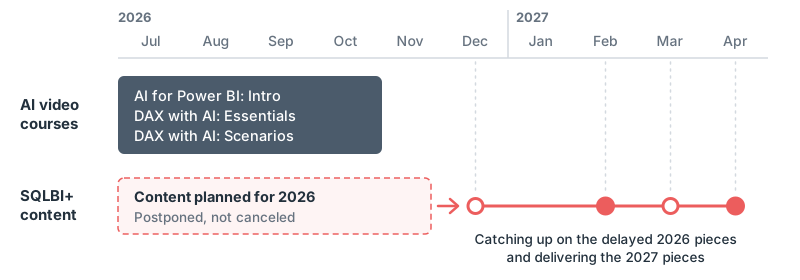
We did not release much new content for SQLBI+ in the second half of 2026, and I want to apologize to our subscribers for that. The content we planned is delayed by a few months, not canceled. Now we are back on track. We plan on catching up on the delayed 2026 pieces and on delivering the 2027 pieces as well.
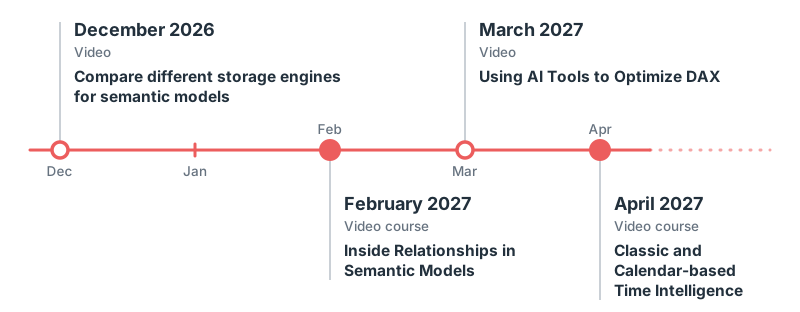
Quick recap: this is the roadmap as of today.
| When | Type | Content |
| Dec 2026 | Video | Compare different storage engines for semantic models |
| Feb 2027 | Video course | Inside Relationships in Semantic Models |
| Mar 2027 | Video | Using AI Tools to Optimize DAX |
| Apr 2027 | Video course | Classic and Calendar-based Time Intelligence |
The roadmap can change because of Microsoft product releases and market demand, but we will do our best to stay within these deadlines.
The rest of this post explains what happened, why, and what you can expect from SQLBI+, which remains a service we are committed to delivering.
What happened in 2026
Long story short: large language models (LLMs) became good at writing DAX code much faster than we expected, with an exponential acceleration after March 2026. That changed our priorities.
We spent the second half of the year creating three new video courses about AI: the free AI for Power BI: Intro, then DAX with AI: Essentials and DAX with AI: Scenarios. These courses could not wait: people are using AI to write DAX today, they’re not planning on starting next year.
Therefore, we postponed the video courses and the white papers planned for SQLBI+ by a few months: we did not change direction, we’re committed to the same volume of content, we just shifted the order of delivery.
What is coming
In December 2026, we will publish a video session that compares the storage engines for semantic models. A semantic model can store data in VertiPaq (Import), in Delta/Parquet (Direct Lake), in DirectQuery over SQL, or in a composite model. We analyze these engines and compare their performance and costs.
In February 2027, we will release the first of two new SQLBI+ video courses: Inside Relationships in Semantic Models. It covers all relationship types available in Power BI semantic models and their performance implications. For example, it explains what changes when you use a relationship in a DirectQuery model or in a composite model.
In March 2027, AI will come back in a video session, this time for performance: Using AI Tools to Optimize DAX. Tools like the Power BI Modeling MCP Server (MCP stands for Model Context Protocol) enable AI tools to test the execution performance of a query. This supports the iteration required to optimize DAX: create a baseline, apply a change, verify that the results are the same, and compare performance.
In April 2027, we shall release the second video course: Classic and Calendar-based Time Intelligence. It is a broader course, and we want it to be the reference with all the details you usually don't find in articles: a complete guide to managing the corner cases you might encounter.
We will also add other video sessions to the roadmap.
The SQLBI+ approach
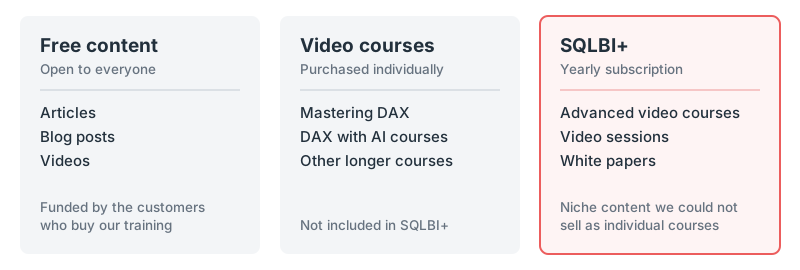
Historically, SQLBI produced free content to promote the brand and to sell more advanced training. The SQLBI business model relied on a small number of paying customers funding content available to everyone.
SQLBI+ started with a different idea: a subscription that funds the production of niche content that would be impossible to sell as individual mini-courses. For example, the white paper and video course about security in semantic models is extremely valuable the day you need it, but it would be hard to sell as an individual course. If it is part of a library, you get the value from the immediate access whenever you need it.
The SQLBI+ model remains valuable: we renew our commitment, and we closely monitor our subscriber retention. As long as the subscriber base sustains this work, we will continue producing content that would not be available otherwise.
We are looking into adapting the website to how agents and humans consume our content. However, the principle remains that SQLBI+ subscribers will continue to have access to that content through their agents as well.
The only thing SQLBI+ does not include is access to our other video courses. The longer courses, such as Mastering DAX and the new AI courses, remain available for individual purchase. SQLBI+ has always been an add-on to that: an advanced library of content for professional developers.
Subscription value
The price of SQLBI+ is not based on the quantity of content we release every year. It is based on the value of having access to an exclusive library of content whenever you need it.
Besides, this is not a new idea. When we launched SQLBI+, we said the goal was to save you research and testing time, and that we expect an advanced user to find one or two pieces of content every year that make a real difference in their work.
For example, imagine you have a performance issue in a composite model. You can spend many hours, if not days, researching and testing, or you can watch a session to review the underlying behavior of the feature and understand the bottleneck you are facing. If you translate the time spent on trial and error into lost revenue, you may find it is a multiple of the SQLBI+ yearly subscription.
Our commitment
We made commitments about the content releases for SQLBI+, and we will fulfill them. We will catch up very soon with what was delayed.
The form of these commitments could change in the future, because the way people and their tools use content is changing. If we must change our commitments, the rule we follow is that a change must give subscribers more value, not less. We will also give enough notice so that you can judge the change before your next renewal.
I prefer to underpromise and overdeliver. The roadmap above includes only what we are ready to commit to today, and we will update it when we add more content.